All content and calculators on TheExportYard.com are provided for informational purposes only. They do not constitute legal, financial, or official customs advice. Government tax formulas, exchange rates, and import legislations fluctuate constantly. Always consult a licensed clearing agent and verify your exact liabilities with the relevant local revenue authority before executing a shipment. TheExportYard.com assumes no liability for financial discrepancies, detained cargo, or risks arising from the use of this information.
Uganda Import Duty Calculator
We updated this page on 6th of May 2026, added interactive Import Duty Calculator with explainers to each section of the calculator.
General Import Considerations For Uganda
Maximum Age Limit:
Passenger vehicles older than 15 years from the date of manufacture are banned from importation into Uganda. This rule is strictly enforced by the Uganda Revenue Authority (URA). Vehicles aged 9 to 15 years attract a punitive 50% environmental levy on the CIF value.Emissions Standards:
All imported vehicles must comply with Euro 4/IV emissions standards. Diesel vehicles must also meet Uganda's national sulphur fuel standard of 50 ppm.Left-Hand Drive (LHD) Permitted:
Both right-hand drive (RHD) and left-hand drive (LHD) vehicles are permitted for import and registration in Uganda. There is no LHD ban.Mandatory Pre-Export Inspection:
A compulsory Road Worthiness Inspection (RWI) must be conducted by the Japan Export Vehicle Inspection Centre (JEVIC) before shipment. Additionally, the Uganda National Bureau of Standards (UNBS) requires a Pre-Export Verification of Conformity (PVoC) certificate for all imported vehicles.UNBS On-Arrival Inspection:
From 1 July 2025, all used vehicles are subject to a mandatory UNBS inspection upon arrival at one of eight designated centres across Uganda, conducted under Uganda Compulsory Standard US 845:2008. The inspection fee is UGX 514,957 (approximately USD 134).Roadworthiness Test:
Every imported used vehicle must pass a roadworthiness inspection before it can be registered on Uganda's eNaTIS system. Vehicles without a valid Certificate of Roadworthiness (CRW) or Certificate of Conformity (COC) incur a 15% CIF surcharge plus additional inspection fees.Digital Number Plates:
First-time registration for digital plates costs UGX 714,300 for motor vehicles, as mandated under the Intelligent Transport Monitoring System (ITMS).No Personal Vehicle Exemption:
Unlike some neighbouring countries, Uganda does not grant duty-free importation for returning citizens on ordinary passenger vehicles beyond the standard personal effects allowance of USD 500.
How Uganda Duty is Calculated?
The Uganda Revenue Authority (URA) applies a layered tax structure on the CIF value (Cost + Insurance + Freight) for imported passenger vehicles. The principal components are:
Import Duty: 25% of the CIF value for standard passenger vehicles. Higher rates up to 35% may apply depending on engine capacity and vehicle classification.
Environmental Levy: A levy designed to discourage the importation of aged, high-emission vehicles. It is applied as a percentage of CIF based on the vehicle's age:
0–4 years: 0%
5–8 years: 20%
9–15 years: 50%
Over 15 years: Import banned
Value-Added Tax (VAT): 18% charged on the sum of CIF value plus Import Duty.
Withholding Tax (WHT): 6% of the CIF value.
Infrastructure Levy: 1.5% of the CIF value (effective 1 July 2025 under the External Trade Amendment Act).
Import Declaration Fee (IDF): 1% of the CIF value (effective 1 July 2025).
Summary of the Layered Calculation Order:
*CIF → Import Duty (25% × CIF) → Environmental Levy (age-based % × CIF) → VAT (18% × (CIF + Import Duty)) → Withholding Tax (6% × CIF) → Infrastructure Levy (1.5% × CIF) → IDF (1% × CIF) → Total Landed Cost.*
The URA maintains a monthly-updated Used Motor Vehicle Valuation Database and reserves the right to disregard a declared invoice value if it does not align with internal fair-market valuations.
Customs rates, legislation, and exchange rates fluctuate. The Uganda Revenue Authority reserves the right to reject a declared invoice value if it does not align with their internal fair-market valuations as published in the monthly Used Motor Vehicle Valuation Database. This tool is intended strictly for financial estimation only. It does not replace the counsel of a licensed Uganda customs clearing agent.
Vehicle Regulations & Safety Requirements For Uganda
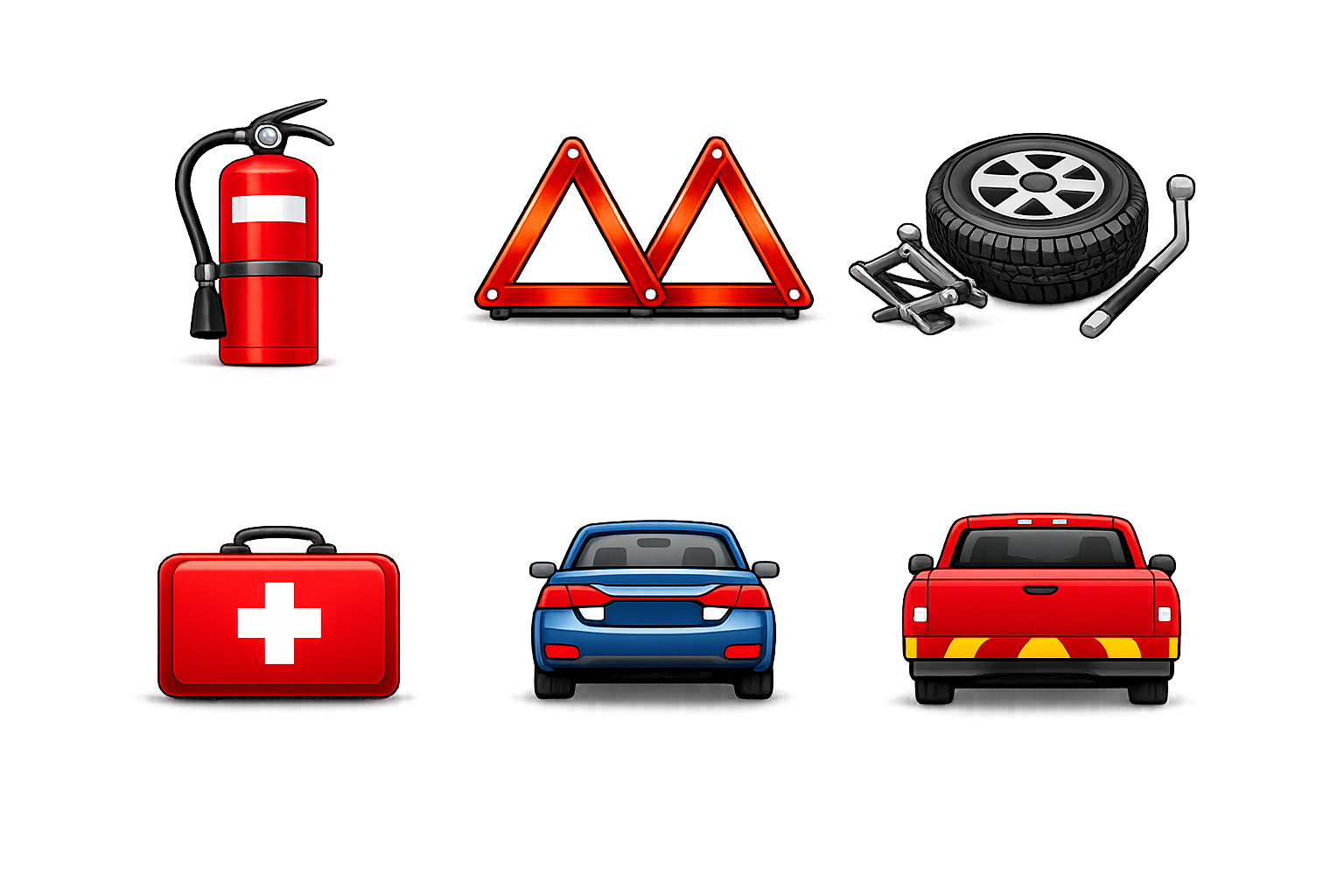
To legally drive an imported passenger vehicle on Ugandan public roads, the vehicle must comply with the Traffic and Road Safety Act, 1998 (Cap 361) and its subsidiary regulations. Below are the mandatory on-road equipment requirements:
Emergency Warning Triangles (All Vehicles)
Every vehicle except a motorcycle must carry at least two emergency warning signs (triangular reflectors) on board.
Specification: Equilateral triangle with each side measuring at least 30 cm, constructed from reflective material, painted red, with reflectors at each corner.
When deployed, signs must be placed at least 45 metres from the stationary vehicle along the road in the direction from which traffic will approach.
Penalty for non-compliance: A fine not exceeding 25 currency points or imprisonment not exceeding one year, or both.
Fire Extinguishers (Personal vs. Commercial)
Private Motor Vehicles: Every private motor vehicle shall be equipped with an efficient fire extinguisher of a pattern approved by the chief licensing officer, maintained fully charged at all times.
Motor Omnibuses (Buses/Minibuses): Every motor omnibus shall carry two fire extinguishers of a type approved by the chief licensing officer, maintained in perfect order and carried in a position readily available for use.
Recommended type: ABC Dry Powder extinguisher, suitable for Class A, B, and C fires (flammable liquids, combustible solids, and electrical fires).
Rear Reflectors
Every vehicle (except a motorcycle without a side-car) must be fitted with a reflector on each side of the rear, at the same height as the longitudinal centre-line, equidistant from each side.
Reflector must be at least 300 mm high but not higher than 1.5 metres from ground level to the centre, kept clean and unobscured.
General Mechanical Condition
All vehicles must have functioning lights, indicators, brakes, and mirrors in good mechanical condition.
Tyres must meet minimum safety standards; a roadworthiness test is required before registration for all imported used vehicles.
Driving Through Other African Countries?
Whilst most countries will have similar mandatory requirements for vehicles on their roads, it is always worth checking before you travel to avoid potential delays or fines. Find out requirements of other countries.
- Scribd.com. (n.d.). Uganda Traffic and Road Safety Regulations, 2012 (S.I. No. 11 of 2012). [online] Available at: https://www.scribd.com/document/793797500/The-Traffic-and-Road-Safety-Reflectors-Regulations [Accessed 6 May 2026].Link
- Uganda Revenue Authority. (n.d.). Import & Export FAQs - Uganda Revenue Authority. [online] Available at: https://ura.go.ug/en/import-export-faqs/ [Accessed 6 May 2026].Link
- Uganda Revenue Authority. (n.d.). Motor vehicle Value Guide - Uganda Revenue Authority. [online] Available at: https://ura.go.ug/en/motor-vehicle-value-guide/ [Accessed 6 May 2026].Link
- Uganda Revenue Authority. (n.d.). Tax Calculators - Uganda Revenue Authority. [online] Available at: https://ura.go.ug/en/tax-calculators/ [Accessed 6 May 2026].Link
- Uganda Traffic and Road Safety Act, 1998 Chapter 361. (n.d.). Available at: https://media.ulii.org/media/legislation/18259/source_file/18c09eb23c431bcb/1998-15.pdf [Accessed 6 May 2026].Link