All content and calculators on TheExportYard.com are provided for informational purposes only. They do not constitute legal, financial, or official customs advice. Government tax formulas, exchange rates, and import legislations fluctuate constantly. Always consult a licensed clearing agent and verify your exact liabilities with the relevant local revenue authority before executing a shipment. TheExportYard.com assumes no liability for financial discrepancies, detained cargo, or risks arising from the use of this information.
South Africa Import Duty Calculator
We updated this page on 6th of May 2026, added interactive Import Duty Calculator with explainers to each section of the calculator.
General Import Considerations For South Africa
Strict Control on Used Vehicles:
The permanent importation of used (second‑hand) passenger vehicles is generally prohibited. You may only import a used vehicle if you have been granted a specific import permit by the International Trade Administration Commission of South Africa (ITAC).Who Qualifies?
Permits are reserved for returning South African residents (absent ≥6 months), immigrants with permanent residency, diplomats, the importation of vintage/collector cars (40+ years), and physically disabled persons with specially adapted vehicles.Import Permit (ITAC):
A mandatory ITAC import permit (Form IE462 for a used passenger vehicle) must be obtained before the vehicle ships. Without it, the vehicle will not be cleared by SARS and could be seized or crushed.Letter of Authority (LOA):
Issued by the National Regulator for Compulsory Specifications (NRCS), this certificate confirms the vehicle complies with South African safety and emissions standards. It is required for every imported vehicle.Left‑Hand Drive Ban:
Only right‑hand drive (RHD) vehicles may be imported and registered for use on public roads. Left‑hand drive vehicles not registered in South Africa before July 2004 are strictly prohibited.No Fixed Age Limit – But Roadworthiness is Mandatory:
There is no single statutory age cut‑off for used passenger vehicles, but any imported vehicle must pass a roadworthiness test at an accredited testing station before it can be registered on the National Traffic Information System (eNaTIS).Pre‑Export Inspection:
JEVIC / QISJ inspections are NOT a mandatory requirement for South Africa. However, the NRCS may accept an international pre‑shipment inspection certificate as supporting evidence of compliance with local safety standards.
How South Africa Duty is Calculated?
The South African Revenue Service (SARS) calculates duties and taxes on imported passenger vehicles in a specific layered order. The main components are:
Customs Value (CIF): Cost of the vehicle (FOB) + Ocean Freight + Marine Insurance.
Customs Duty: 25% of the CIF value for passenger vehicles imported from most countries. Vehicles originating from the EU attract 18%, and those from SADC countries may attract 0% (subject to local content rules).
Ad Valorem Excise Duty (Luxury Tax): Applied to vehicles exceeding approximately R250,000 in retail value. The rate is calculated using the formula: % = [(0.00003 × (Retail Value – 20%)) – 0.75], capped at a maximum of 30%.
Value‑Added Tax (VAT): 15% is charged on the Added Tax Value (ATV). The ATV formula is: [(Customs Value + 10% thereof) + any non‑rebated duties] × 15%. The 10% uplift applies to imports from countries outside the Southern African Customs Union (SACU).
Carbon Tax (Environmental Levy): R146 per gram of CO₂ emissions per kilometre above the 95 g/km threshold for passenger vehicles.
Summary of the Layered Calculation Order:
*CIF → Customs Duty (25% of CIF) → Ad Valorem Excise Duty (on retail value) → ATV (CIF + 10% uplift + total duties) → VAT (15% of ATV) → Total Landed Cost.*
Customs rates, legislation, and exchange rates fluctuate. The South African Revenue Service (SARS) reserves the right to reject a declared invoice value if it does not align with their internal fair‑market valuations. This tool is intended strictly for financial estimation only. It does not replace the counsel of a licensed South African customs clearing agent.
Vehicle Regulations & Safety Requirements For South Africa
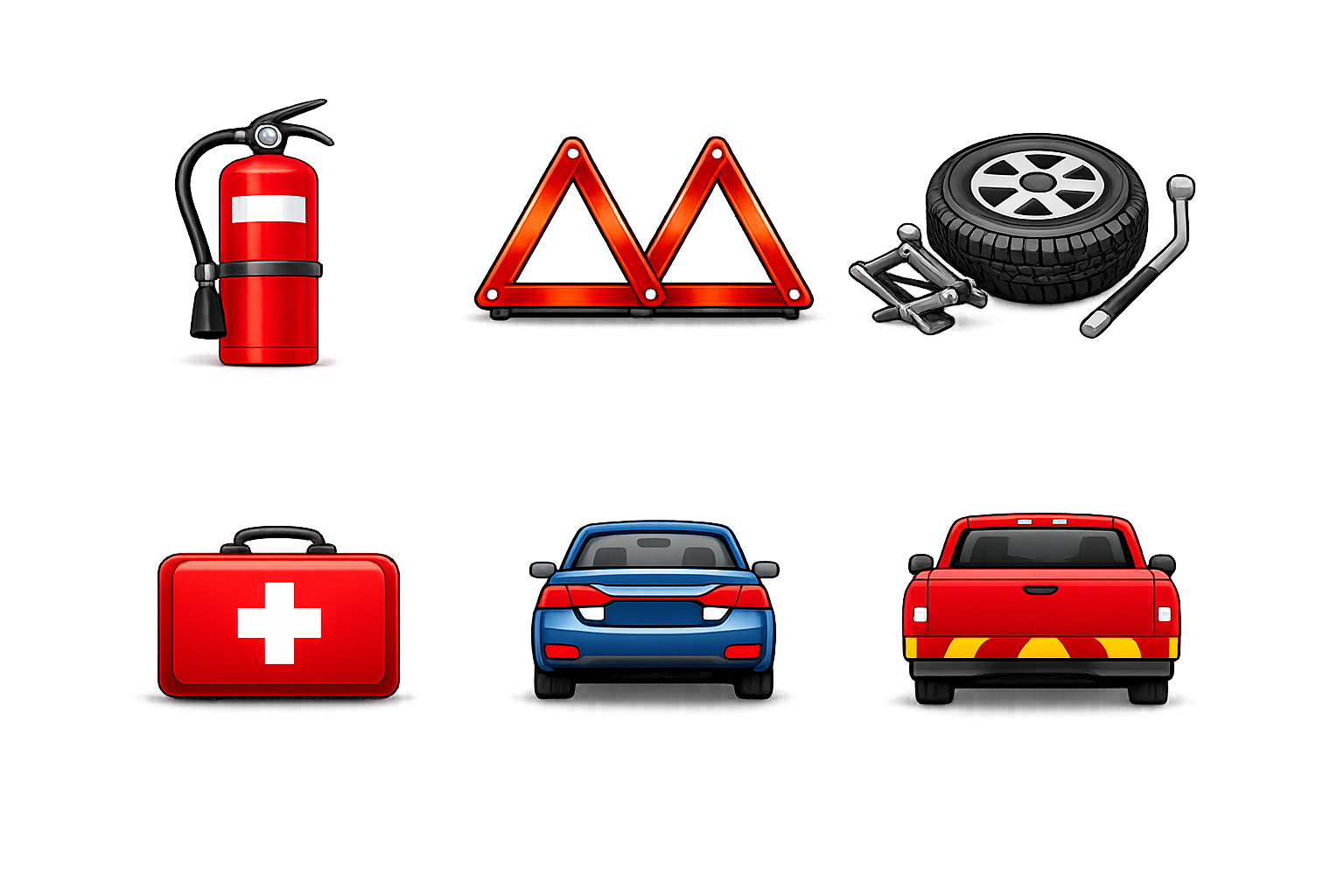
To legally drive an imported passenger vehicle on South African public roads, the vehicle must comply with the National Road Traffic Act (Act No. 93 of 1996) and its regulations. Below are the mandatory on‑road equipment requirements:
Warning Triangle:
Every passenger motor vehicle first registered on or after 1 July 2007 must carry at least one emergency warning triangle that complies with SANS 1329‑1 and bears a certification mark. When the vehicle is stationary on a public road or its shoulder, the triangle must be placed not less than 45 metres behind the vehicle.Fire Extinguisher (Commercial Use):
A fire extinguisher is not required by national law for private passenger vehicles. Under Regulation 260 of the NRTA, only minibuses and buses operated for reward must carry a 1 kg (minibus) or 2.5 kg (bus) dry‑powder extinguisher.Spare Wheel:
The NRTA does not explicitly mandate a spare wheel for passenger cars, but a roadworthy vehicle must have tyres with a minimum tread depth of 1 mm across the entire width.Reflectors & Retro‑Reflective Marking:
Standard passenger vehicles do not require side‑ or rear‑retro‑reflective contour markings. Reflective contour markings under Regulation 192A apply only to heavy goods vehicles (>10 000 kg GVM), long vehicles (>6 m), and trailers.Seatbelts:
All seating positions must be fitted with seatbelts that comply with SANS 1080 and bear a certification mark.Mirrors & Wipers:
At least two functioning mirrors and a working windscreen wiper are compulsory.
Personal vs. Commercial Vehicles:
As noted above, fire extinguishers are mandatory only for commercial passenger transport (taxis, buses). Private passenger vehicles are exempt from the fire extinguisher requirement under national law, though certain municipalities may have their own by‑laws.
Driving Through Other African Countries?
Whilst most countries will have similar mandatory requirements for vehicles on their roads, it is always worth checking before you travel to avoid potential delays or fines. Find out requirements of other countries.
- International Trade Administration Commission (ITAC). (2025). Application Forms - International Trade Administration Commission (ITAC). [online] Available at: https://itac.org.za/import-control/application-forms/ [Accessed 6 May 2026].Link
- SARS (2023). SCHEDULE 1 / PART 1 CUSTOMS DUTY. [online] Available at: https://www.sars.gov.za/wp-content/uploads/Legal/SCEA1964/Legal-LPrim-CE-Sch1P1Chpt1-to-99-Schedule-No-1-Part-1-Chapters-1-to-99.pdf [Accessed 6 May 2026].Link
- South African Revenue Service. (n.d.). Duties and Taxes for Importers. [online] Available at: https://www.sars.gov.za/customs-and-excise/duties-and-taxes/duties-and-taxes-for-importers/ [Accessed 6 May 2026].Link
- South African Revenue Service. (n.d.). Importation of a second-hand vehicle | South African Revenue Service. [online] Available at: https://www.sars.gov.za/media-release/importation-of-a-second-hand-vehicle/ [Accessed 6 May 2026].Link