All content and calculators on TheExportYard.com are provided for informational purposes only. They do not constitute legal, financial, or official customs advice. Government tax formulas, exchange rates, and import legislations fluctuate constantly. Always consult a licensed clearing agent and verify your exact liabilities with the relevant local revenue authority before executing a shipment. TheExportYard.com assumes no liability for financial discrepancies, detained cargo, or risks arising from the use of this information.
Kenya Duty Calculator
We updated this page on 3rd of April 2026, added interactive Import Duty Calculator with explainers to each section of the calculator.
General Import Considerations For Kenya
Before calculating costs, ensure your vehicle is legally permitted to enter Kenya borders:
The 8-Year Age Rule:
The importation of used passenger vehicles older than 8 years from the year of first registration/manufacture is strictly prohibited under the Kenya Bureau of Standards (KEBS) KS 1515:2000 standard. The vehicle must be shipped, arrive, and be cleared before the end of the 8th calendar year.Right-Hand Drive (RHD) Mandate:
Kenya strictly enforces a ban on Left-Hand Drive (LHD) vehicles for general use. Exemptions are only granted for special purpose vehicles (e.g., ambulances, fire engines, or large construction vehicles).Mandatory QISJ Inspection (PVoC):
All used vehicles imported from major markets (Japan, UK, UAE, South Africa) must undergo a Pre-Export Verification of Conformity (PVoC) by Quality Inspection Services Japan (QISJ). You must obtain a Certificate of Roadworthiness (CoR) before the vehicle is loaded onto the ship. Arriving without this certificate will result in severe penalties or the vehicle being shipped back at your expense.
How Kenya Duty is Calculated?
The Kenya Revenue Authority (KRA) uses an ad valorem system that calculates taxes sequentially.
Important Note: KRA does not always use your commercial invoice value. Instead, they use a Depreciation Matrix applied to the Current Retail Selling Price (CRSP) of that specific vehicle model when new.
Here is the exact compounding formula applied in our calculator (using your declared CIF/Customs Value):
Customs Value (VDP): The baseline value used by KRA (either your CIF or the depreciated CRSP value).
Import Duty: Under the revised EAC External Tariff, passenger motor vehicles attract a flat 35% duty applied strictly to the Customs Value.
Excise Duty: This is a compounding tax calculated on the sum of (Customs Value + Import Duty). The rate varies by engine capacity and fuel type:
Petrol up to 1500cc: 20%
Petrol over 1500cc: 25%
Diesel up to 1500cc: 25%
Diesel over 1500cc: 35%
Fully Electric Vehicles (EVs): 10%
VAT (Value Added Tax): A flat 16% calculated on the Value for Tax Purposes (VTP). Your VTP is the sum of Customs Value + Import Duty + Excise Duty. (Note: EVs currently enjoy a 0% VAT exemption to promote e-mobility).
Processing Levies: Comprised of the Import Declaration Fee (IDF) at 2.5% and the Railway Development Levy (RDL) at 1.5%. Both are calculated strictly on the base Customs Value.
Your Total Payable at the Port = Import Duty + Excise Duty + VAT + IDF + RDL.
Customs rates, legislation, and exchange rates fluctuate. Kenya Revenue Authority (KRA) reserves the right to reject a declared invoice value if it does not align with their internal CRSP fair-market valuations. This tool is intended strictly for financial estimation only. It does not replace the counsel of a licensed Kenya customs clearing agent.
Vehicle Regulations & Safety Requirements For Kenya
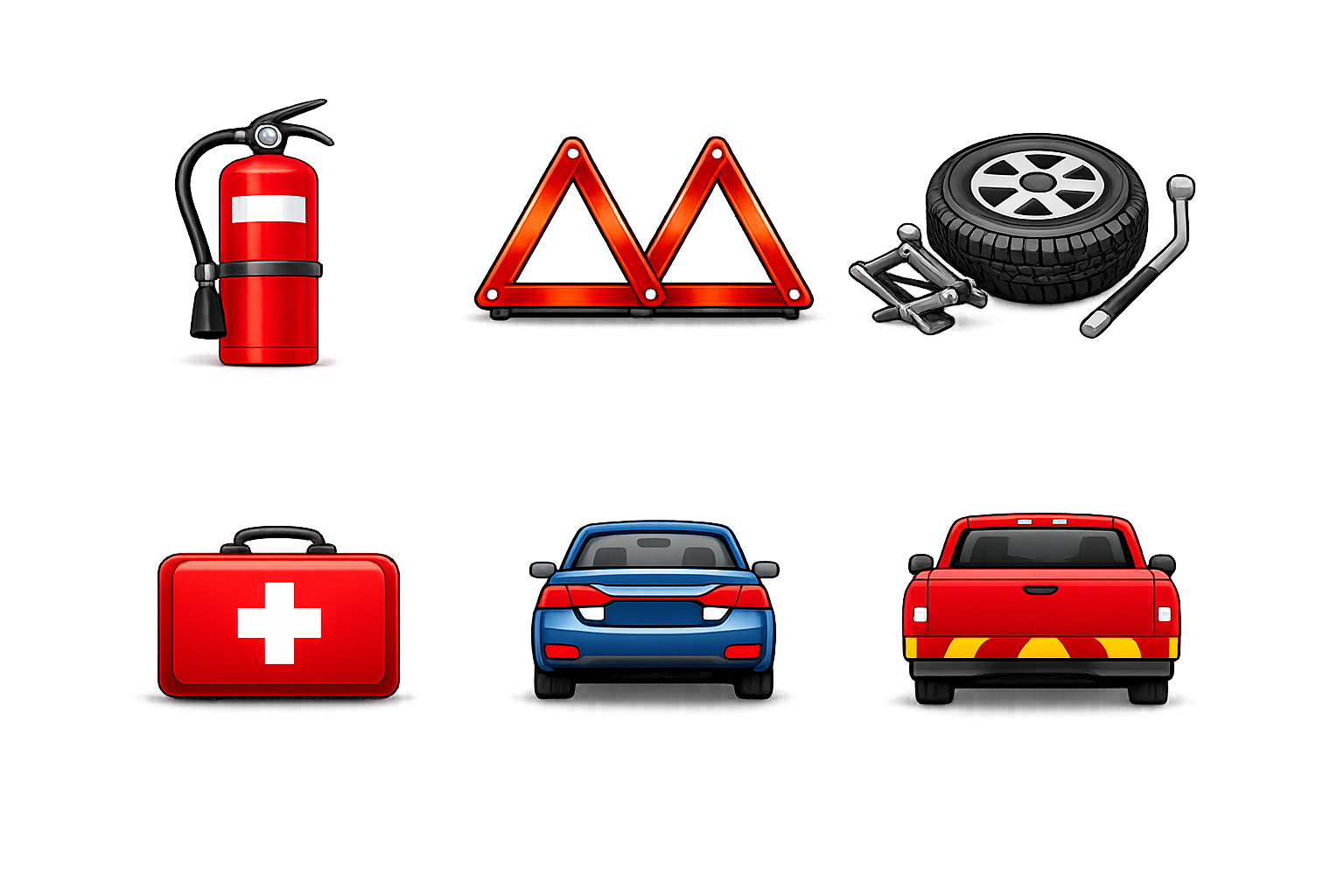
To legally drive your newly imported vehicle away from the Container Freight Station (CFS) and avoid impoundment by the National Transport and Safety Authority (NTSA) or Traffic Police, your vehicle must strictly comply with the Traffic Act (Cap. 403).
Mandatory Equipment for ALL Passenger Vehicles:
Serviceable Fire Extinguisher:
You must carry a minimum 1kg dry-powder fire extinguisher. It must be KEBS certified, fully charged (gauge in the green), and securely mounted inside the passenger cabin.Reflective Warning Triangles:
You are required to carry a pair (2) of reflective red warning triangles (lifesavers). They must be highly reflective on both sides to warn oncoming traffic during a breakdown.First Aid Kit:
A fully stocked first aid kit is highly recommended and standard practice for road safety compliance in Kenya.Spare Wheel & Tools:
Your vehicle must be equipped with a roadworthy spare tire, a functional jack, and a wheel spanner.
Commercial Vehicle Additions (Matatus, Pickups, Vans):
If your vehicle is classified as commercial or a Public Service Vehicle (PSV), NTSA enforces severe additional regulations:
Speed Governors:
All commercial vehicles must be fitted with an NTSA-approved speed limiter restricting the vehicle to 80 km/h.Reflective Striping:
Commercial goods vehicles must have continuous red reflective tape (chevrons) across the rear and white reflective tape across the front. PSVs must have a continuous yellow reflective line painted along the sides.
Driving Through Other African Countries?
Whilst most countries will have similar mandatory requirements for vehicles on their roads, it is always worth checking before you travel to avoid potential delays or fines. Find out requirements of other countries.
- InfoTrade Kenya. (n.d.). TRAFFIC ACT CHAPTER 403. [online] Available at: https://infotradekenya.go.ke/media/Traffic%20Act%20CAP%20403.pdf [Accessed 3 Apr. 2026]. Link
- Kenya Bureau of Standards. (n.d.). KENYA STANDARD DKS1515: 2025 - Road vehicles — Inspection of road vehicles — Code of practice. [online] Available at: https://www.kebs.org/wp-content/uploads/2025/03/DKS-1515_2025-Road-vehicles-%E2%80%94-Inspection-of-road-vehicles-%E2%80%94-Code-of-practice-.pdf [Accessed 3 Apr. 2026]. Link
- Kenya Revenue Authority. (n.d.). Facts About KRA - Motor Vehicle Importation. [online] Available at: https://kra.go.ke/helping-tax-payers/facts-about-kra/category/6 [Accessed 3 Apr. 2026]. Link
- Kenya Revenue Authority. (n.d.). Procedures for Motor Vehicle - KRA. [online] Available at: https://www.kra.go.ke/individual/importing/learn-about-importation/procedures-for-motor-vehicle [Accessed 3 Apr. 2026]. Link